For many first time buyers in London, getting on the housing ladder can be challenging enough – compromise is usually key. But for Artistic Access Consultant Katie McConnell, 23, the list of requirements for her first home was non-negotiable.
“I needed step-free access, an accessible bathroom, space for my wheelchair and somewhere suitable for my assistance dog, Bella,” she explains.
After training at drama school and spending her early career as a performer in the theatre, Katie became disabled and found opportunities on stage increasingly limited. Rather than leave the industry altogether, she now works with theatres, producers and creative organisations to improve accessibility for disabled performers and audiences.
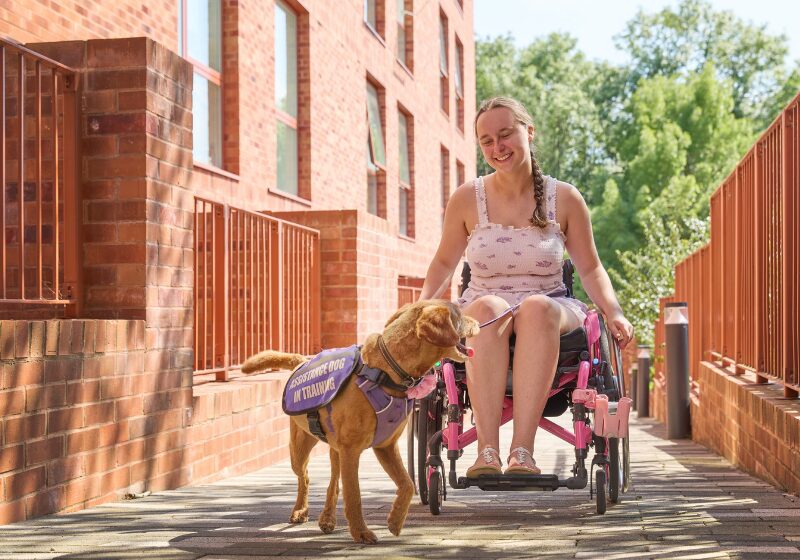
Her efforts have also had to extend to the property industry. “Whilst renting and starting my homeownership journey, I have found myself having to educate most of the people I have come across in the process,” she says.
But Katie was determined to fulfil her ambition of owning a home in London with her partner. “Living in London felt achievable to me only because nothing has ever felt unachievable to me,” she explains. “Having been in an industry that often isn’t accommodating, I’m used to working hard to reach my goals.”
Having previously rented in Norfolk, Katie and her partner moved back in with her mum in London to begin the search for a suitable home. The property’s location was as important as the property itself, as just 33% of London Underground stations are accessible.
“I’m in and out of central London a lot for work, so I needed to work backwards,” she says. “I looked at what stations were accessible in Theatre Land and narrowed down the search to areas on tube lines servicing those stations – some were out of our price range or a little too far out, so we quickly figured out a radius that would work.”
After some challenging viewings, including one where Katie couldn’t even get inside – “there were stairs to enter the building, so I couldn’t access the lift in the foyer,” she recalls – she spotted a Pocket Living development advertised in an email from her estate agent.
Pocket Living is an innovative housing developer that delivers discounted one-bedroom apartments to first time buyers in London, with homes currently for sale in Walthamstow, Harrow and East Croydon.
“This was the fifth property we viewed and it was really straightforward to organise. After looking around the flat and the roof terrace, which was also accessible, we got vouchers for a coffee shop nearby which was really nice. It made it seem like a real community and that was a big selling point for us. Soon after we decided to move ahead with Pocket ,” Katie explains.
“Moving was extremely quick – we worked hard for it, but the whole process of viewing, offering, signing a mortgage contract and moving in was far less stressful than I expected. We’re definitely privileged to have secure careers and the ability to buy a house at this age, but we were pleasantly surprised by how smooth the process was with Pocket.”
Katie also found it easy to work with Pocket to ensure her home was suitable for her specific needs, including installing a custom wardrobe to reach all her clothes from a seated height.
“The property was already very accessible when we first viewed it, which was an incredible selling point,” she says. “I don’t think people realise how long and strenuous the process can be to install ramps or widen doors in a property. It’s taken so much stress away.”
When renting, even basic accessibility improvements to meet Katie’s needs were off limits. “I didn’t have an accessible home when renting and it was virtually impossible to do so,” she says.
Only 3.3% of open market homes in England are fully wheelchair accessible according to a 2025 report from Habinteg Housing Association, with findings suggesting that in the best case scenario there will be one new wheelchair accessible home delivered for every 210 people in Greater London. In the North West of the country there will be just one new wheelchair accessible home for every 2,006 people in the population.
For many disabled renters, including Katie, temporary solutions are the only option.Katie explains: “When we rented we weren’t allowed to put permanent grab rails in the shower, so I relied on adhesive ones which weren’t safe.”
Homeownership has been transformative for Katie’s independence as well as her peace of mind.
“I work from home a lot and am sometimes housebound due to my chronic illness, so it’s been incredible to have a blank canvas and create a space that feels like a haven. To have a home that’s completely level access throughout is just unheard of, and the outside and communal areas are all accessible.”
Pocket developments include co-working spaces and rooftop gardens, encouraging residents to get to know their neighbours – and, in Katie’s case, for her neighbours to get to know her assistance dog Bella, a four-year-old mini wirehaired Labradoodle.
“Bella loves her new home and the surrounding green areas, and our neighbours love her,” Katie says. “Everyone is very friendly – when we’re on our way in or out of the building, people say hello to me but most of them will say hello to Bella first!”
“It’s really lovely that we live in a place where you can have real human interactions. When you’re in and out of central London, you don’t get that all the time.”
Reflecting on her homebuying journey, Katie recognises the systemic challenges first time buyers face.
“I think there should be more onus on the industry and government to educate themselves on how they can better support first time buyers, especially those that face additional barriers to buying a property, taking some of the burden away from buyers who are having to advocate for themselves.”
Katie’s advice to prospective first time buyers is to commit to saving over a longer period of time and have a clear understanding of the market you’re looking in.
“As soon as I turned 18, I prioritised putting the maximum amount into my LISA every year, and compromised on other things like clothes or days out. It’s also important to be clear on what you want early on – not just wanting to buy your first house, but whereabouts and what it might look like. Knowing your budget doesn’t help unless you know what your budget can get you. Being aware of the market and its fluctuations was really helpful.”
You can follow Katie’s journey as a Disability Advocate and Artistic Access Consultant, via her Instagram @katieanna.mcconnell.
All Pocket homes are designed to be accessible for a wide range of occupants and their guests, including older people, those with reduced mobility and some wheelchair users, and can often be adapted further based on the owners’ requirements. In addition to this, most Pocket developments also include specifically designed M4(3) adaptable wheelchair user homes.
To be eligible to purchase a Pocket home, the prospective buyer can’t already own another property, and must live or work in London. All buyers must earn under the Mayor of London’s income threshold for affordable housing (currently £90,000). When the homes are sold on, new purchasers must meet the original criteria including a household income below the Mayor of London’s affordable housing threshold.
Buyers own 100% of their property, which is sold at a 20% discount to the local market.
For more information or to register interest, prospective buyers can visit www.pocketliving.com or call 020 7291 3683.